
Beyond the Tap: Understanding Radon in Georgia's Well Water
When most Georgia homeowners hear the word "radon," they immediately think of the invisible gas seeping through their basement floor or crawlspace. However, for those living in rural or semi-rural areas, there is another potential source often overlooked: your private well.
If your home relies on groundwater, radon may be entering your living space every time you turn on the faucet. Understanding these risks and knowing how to interpret your test results is the first step toward a safer home.
How Radon Enters Your Water Supply
Radon is a naturally occurring radioactive gas produced by the breakdown of uranium in soil and rock. According to the UGA Extension (Radon in Your Water Publication), radon is chemically inert, meaning it does not react with its environment and travels easily through soil and water.
While public water systems typically treat and aerate water to remove gases before it reaches your home, private wells pull water directly from the ground. In areas with granite or uranium-bearing rock—common in many parts of Georgia—this water often carries dissolved radon directly into the household.
Why Radon in Water Matters
Radon in water is not usually a major concern when it is consumed. The primary risk comes from radon released into the air during everyday household activities such as:
-
Showering
-
Washing dishes
-
Doing laundry
When radon escapes from water into indoor air, it can add to the overall radon level inside the home. In some cases, radon from water can meaningfully contribute to elevated indoor air readings.
Radon in Water vs. Radon in Air
It’s important to understand the difference between these two exposure paths.
-
Radon in air is the leading concern for health risk and is the main focus of testing and mitigation.
-
Radon in water is typically a secondary source and is most relevant when indoor air tests show elevated levels and the home uses well water.
For this reason, professionals often recommend testing indoor air first. Water testing is usually considered when air test results are high and a private well is present.
Homes Most Likely to Be Affected in Georgia
In Georgia, radon in water is most commonly associated with:
-
Homes using private wells
-
Properties located in areas with granite or uranium-bearing rock
-
Rural or semi-rural homes outside municipal water systems
That said, radon levels can vary widely from one property to another—even between neighboring homes—making testing the only reliable way to know.
When Should Homeowners Test Their Water for Radon?
Water testing is not necessary for every home. It may be worth considering if:
-
Your home uses a private well
-
An indoor air test shows elevated radon levels
-
You are buying or selling a home with a well system
-
You want a complete picture of your home’s radon exposure
How Radon in Water Is Addressed
If elevated radon levels are found in water, treatment options focus on removing radon before it enters the home or before it is released into indoor air. Common approaches include:
-
Aeration systems, which release radon from water before it enters the household supply
-
Granular activated carbon (GAC) systems, which capture radon as water passes through
The appropriate solution depends on radon concentration, water usage, and overall household needs.
Radon, Water, and Real Estate Transactions
Radon in water may come up during real estate transactions involving private wells. Buyers may request testing to better understand indoor air quality and overall exposure. Addressing radon questions early can help prevent confusion and delays later in the process.
For sellers, understanding radon in both air and water supports transparency and builds buyer confidence—especially in rural Georgia markets.
Taking a Practical, Informed Approach
Radon in water is not something most homeowners need to worry about daily. However, for homes with private wells, it is a topic worth understanding—particularly when indoor air tests show elevated readings.
By starting with air testing and following up with water testing when appropriate, Georgia homeowners can make practical, informed decisions without unnecessary stress.
Why Radon in Water is a Health Concern
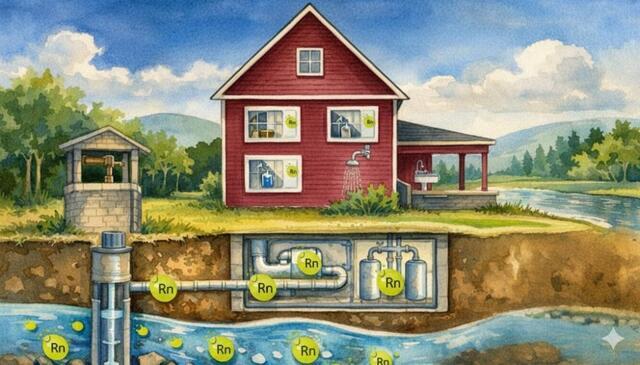
The primary health risk from radon in water isn't actually drinking it—it’s breathing it. When you shower, wash dishes, or do laundry, the radon gas "escapes" from the water and enters your indoor air.
-
The Inhalation Risk: For every 10,000 pCi/L of radon in your water, it typically adds about 1 pCi/L to your home’s total indoor air concentration.
-
The Ingestion Risk: While secondary to inhalation, the EPA and the International Agency for Research on Cancer (IARC) consider radon a human carcinogen that can damage sensitive internal organs when ingested.
Interpreting Your Radon Water Test Results
If you test your well water, the results are measured in picoCuries per liter (pCi/L). The University of Georgia Agricultural and Environmental Services Lab has adopted the following interpretations for these results:
Radon in Drinking Water: Test Result Interpretations
-
Below 100 pCi/L: Similar to normal background levels; poses no health risk from ingestion.
-
100 – 300 pCi/L: "Slightly elevated" but poses no significant health risk from ingestion.
-
301 – 4,000 pCi/L: May pose an elevated health risk due to ingestion; a treatment system for removal of radon from water may be considered.
-
Above 4,000 pCi/L: Significant health risk. Treatment is recommended as results may additionally lead to increased indoor air radon concentrations. Testing for uranium and radium is also advised at this level.
Note: The highest known concentration measured in a Georgia well was 140,000 pCi/L, highlighting how variable and extreme these levels can be.
Removing Radon from Home Water
Because radon gas is released from water at various points (showering, sinks, etc.), the UGA Extension emphasizes removing it at the Point-of-Entry (POE)—before it enters your home’s plumbing. There are two primary treatment approaches:
1. Aeration Treatment
This system bubbles air through the water or draws it into a holding tank, allowing the radon gas to be safely vented outside.
-
Effectiveness: Up to 99%
-
Approximate Cost: $4,000 installed.
2. Granular Activated Carbon (GAC) Treatment
This technology traps radon onto carbon surfaces until it decays. It is recommended that these systems be located outside the home, as decay products can accumulate in the filter.
-
Effectiveness: >95% (for levels below 30,000 pCi/L)
-
Approximate Cost: $1,000 installed.
Professional Guidance for Georgia Homeowners
When choosing a system, look for certifications from the National Sanitation Foundation (NSF) International or the Water Quality Association (WQA). These certifications ensure the product will perform as specified.
If you are buying or selling a home in Georgia with a private well, addressing radon early is key. For more detailed information on specific equipment, refer to University of Georgia Extension Bulletin 939, "Water Quality and Common Treatments for Private Drinking Water Systems."